Showing posts with label games. Show all posts

Tuesday, March 9, 2021

Gamification - Educational games for teachers


What is gamification?
  It is the use of the mechanics from games to create engaging learning experiences for your students.  Consider what motivation you have available from gamification:

·       Accumulation of points – daily, weekly, even monthly.  Points = success. Points can translated into prizes.

·       Levels of achievement – begin at level 1 and continue to the last level.  You know how children love to be able to finish a level when they are called to dinner!

·       Avatars raise interest – your students can create real or virtual avatars for your real or virtual games. 

·       Badges – your students can accumulate badges in a chart or notebook to show progress.

·       Fun – when students see that fun is around the corner in the form of a game, they are more likely to cooperate with your less-than-fun lessons or assessments.  Let’s face it – we can’t play games all day long!

Let’s look at each of those strategies individually.

Points – When you play a game, you don’t always need to assign points, but when you do, here are some ideas:

·       Offer “experience” points in addition to, or instead of, earned points.  For example, when your students play a game, there’s nothing wrong with giving experience points for joining in the game.  But you can also assign extra points for winning the game. That way, everybody gets some points.

·       I’m not a fan of competition.  I think it is self-defeating when someone in your class consistently comes in last. That’s why I offer the NO leaderboard theory.  You could, however, keep a cumulative total of everyone’s points.  When the entire class reaches 1,000 points, for example, they would earn a classroom reward. Everybody wins!

Levels – When you start your gamification, start on Level 1, just like on video games.  Start easy and get progressively more difficult as you progress through different levels of instruction.  Also, instead of levels, which children have come to regard as stressful to achieve, you might call your “levels” stages or steps. 

Avatars – A relatively new word to the educational scene is avatar, made popular by the movie of the same name.  When you use online games, encourage your students to create avatars that depict their personality.  Or, you might put the hand-drawn avatars on your bulletin board to showcase everyone who is playing the games (naturally, that will be everybody).  If you use push pins, you can move the players around occasionally to add interest.

Badges

– Just like scouts, badges show achievement.  However, unlike the national organization, your badges can be in a notebook – either digital or tactile – instead of on a visible sash.  It’s easy to create badges for your various “stages” of achievement.  For example, if you are teaching times tables, you might have badges for each of tables from 2 to 12.  When students demonstrate mastery, they would earn a 5 badge, or a 12 badge, etc.  To the right is an example that you can make.
I simply found it by doing a search within a word document! Other badges might have a picture of a log cabin when you finish the Colonial America unit, perhaps.

Fun – Fun comes in many forms, but the most rewarding is when there is no external reward at all!  Here are some ideas:

·       Let your students develop their own educational games that the whole class can play.  Here is a link to directions for making your own board game:  Build a Better Board Game. This is a great group activity.  When everyone is done, they will explain their game, and then play with the rest of the class. This helps develop their communication skills.

·       Ask students to experiment with ways to improve their points or stages.  This gives them valuable practice in the scientific method of investigation. And students feel a sense of control over their outcomes.

·       Have them establish goals for themselves – a valuable life skill!

·       Adapt current games to become educational vehicles.

o   Checkers – odd vs. even squares so young learners can see the difference.

o   Jeopardy – create your own game by following THIS LINK to a blank game, complete with the Jeopardy! tune.

o   Use Wheel of Fortune to review vocabulary sentences and phrases.  Here is one of many customizable FREE digital spinners that also includes name pickers: Spinners and Pickers.

o   Put your creative thinking cap on an adapt the games you already have in the classroom to become educational adjuncts to your curriculum.  Post your ideas at the end of this article for others to share.


Conclusion – Gamification can be used and adapted for all learning styles and abilities. It helps keep students motivated and increases their attention span.  With gamification, you highlight student progress instead of constantly red-marking their mistakes on a test.  Gamification in the education industry will grow from $450 million in 2018 to $1.8 billion in 2023.  Are you ready to help your students join the gamification education network?  Try making and posting some of your own games!  Here are some of mine:

Socially Distant Games for Grades 4-8 - Indoors, Outdoors, and Virtual

Get those kids moving - active lesson tips in "The Kinetic Classroom"

And some Bingo games I created using Bingo Baker:

Periodic Table Bingo

State Shapes, Flags, and Capitals Bingo

Women Inventors Bingo Game and Research Guidelines


Monday, January 20, 2020

A fun, new STEM and creative writing card game!


Are you looking for a fun, educational game to play with your students or children at home?

Creative Connections is a non-competitive, cooperative card game that everyone can play.

Simply print out the cards and directions, and then give a set to each group, or play as a class with all groups participating at once.  You'll find yourself having fun while the kids truly enjoy learning about STEM connections.

An added bonus of this game is that after the students make STEM connections, they get to create a prompted story from the connections they made!

Perfect for ages 8 to adult.


Fun for fillers and end of the year!

Wednesday, November 4, 2015

FREE MATH LESSON - Turkey Math Bingo Freebie

 
Turkey Math Bingo FREEBIE ( Grade 3-5)

A fun math Bingo game for Thanksgiving! 
Before starting the game students randomly place their turkey squares on their empty grid and write the correct answers for each square. 
This covers basic and advanced operations, multiples and factors.


There are 3 different versions of the game suitable for Grades 3 - 5.
Common Core aligned:
✪ Grade 3 3.OA.A.1 3.OA.A.2 
✪✪ Grade 4 4.OA.B.4 4.OA.C.5 4.NF.B.4.B
✪✪✪ Grade 5 5.OA.1 5.OA.B.3 5NBT.7


The game uses an Activboard feature to all you to randomly choose Turkeys during the game.
The best part is that the game can be reused multiple times. 
Hope you have lots of fun with this!

Visit my store here!


Tuesday, June 30, 2015

Brush up on that Canadian vocabulary - it's nearly July 1st! Canada Day (eh?)

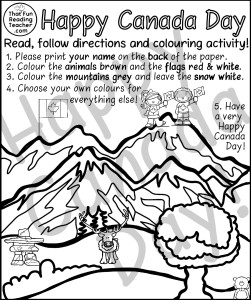
Canada day cover for post.png
   Happy Canada Day, everyone! 
I write this to you on the eve of Canada's 148th birthday! 
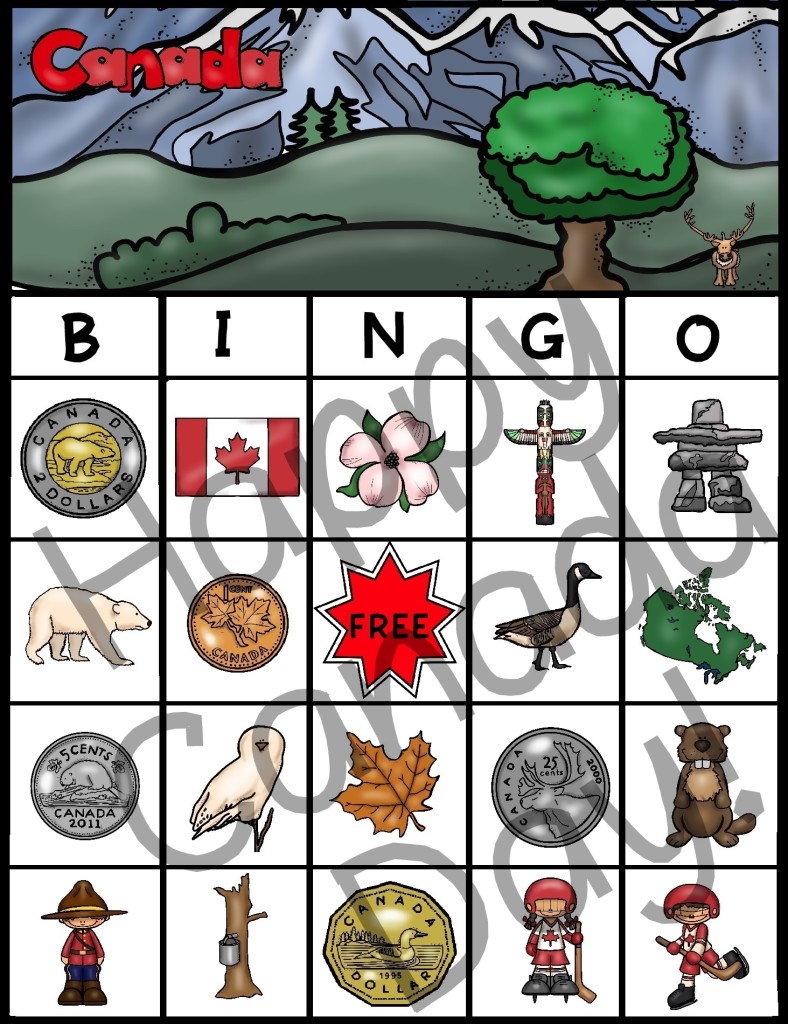
For those of us who are Canadians of a certain age, life experience and education, the images below are easy to name and contain a number of our national symbols.
BINGO.png
Do you know anyone who could benefit from brushing up on their Canadian vocabulary?


demoCanadaCanadaBingo

BINGO is a fun way to do it at any age!


BINGO game cover Th1 Canada freebie Canada freebie.png

Like the freebie?
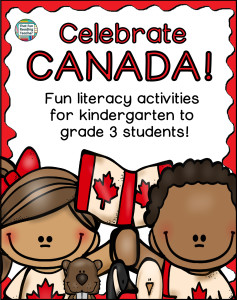
Here is another Celebrate Canada Product, this one focused on Early Literacy, which can be purchased in a bundle with the Celebrate Canada BINGO game:

Canada Literacy preview.png

Click the links below to my TpT store for the Celebrate Canada Literacy activities or Bundle, or to explore other areas of the site with related Canadian content!

Canada cover.png Th1 Canada Bundle cover 350 RobMunsch1

Cndn TpTers CanDayStories

And have a Happy Canada Day!!!!!
Follow That Fun Reading Teacher's board Celebrate Canada Day! on Pinterest. TpT Store Prof pic circle           
http://thatfunreadingteacher.com/ 
ThatFunReadingTeacher@gmail.com 
Click the symbol above to access my TpT Store! ;)  

Monday, June 8, 2015

Money Puzzle Package

Now is a great time to get smart with money through fun and creative puzzles from my Money Puzzle Package. 


This bundle of fun contains a sudoku puzzle,

a creative art project, 

a quote puzzle, 

and two matrix logic puzzles, 


along with answer keys all for $3.25. That's a bargain considering each of these items sell for $1 a piece.

Please stop by my store to check out my 
Money Puzzle package, today!


Wednesday, March 25, 2015

FREE resource- Disappearing Tulips Game


As a speech therapist, I love using games in therapy to reinforce any skill.  I made this fun MATH FREEBIE GAME that works on math concepts as well as helps my kids stay motivated during my speech sessions.

This is a great game for Spring!  Grab this freebie HERE!

Stay Connected with me!

Tuesday, March 24, 2015

Misc. Lesson - "food groups"

March is National Nutrition Month!

I am thinking about the special days that we celebrate with our students every year and am looking ahead to the next several observations.  In recent weeks, we've celebrated the one hundredth day of school, Valentine's Day, Dental Health Month, and the birthday of Dr. Seuss.

One thing that I often neglect to observe is "National Nutrition Month".  "National Nutrition Month" takes place in the month of March.  Usually, it's not a big event in the classroom.  Yet, I want children to form healthy eating habits that they will take with them throughout their lives.  I want them to make informed choices about the foods they are putting in their mouths.  I DON'T want them to be consuming foods that are filled with empty calories.  How can I help them to do that if they are not taught the basics of proper nutrition?

Back in the "Good Old Days" health lessons were part of the curriculum.  The emphasis now is on the core subjects of math, language art, science, and social studies.  It seems that the subject of health is getting neglected more and more.

In the past, we had a food pyramid graphic displayed.  The pyramid would show examples of the foods we should be eating from the four main food groups.  The pyramid changed over the years and there is a NEW graphic now.  It's a PLATE.  I found it at the Choose My Plate website.  This website is a great source of information about food.  The website has a tool called "Food-A-Pedia". "Food-A-Pedia" allows one to collect information about almost any food imaginable.  Just type in the food and it will tell what food group it is classified in as well as the number of calories in a serving.  One odd thing about the website is that a tomato is categorized as a vegetable.  Hmm. . . .  I would beg to differ on that one. It makes sense to change the graphic to a plate because children can CONNECT more easily to the idea of a plate than to one of a pyramid.  Another change that I noticed was the food groups themselves.  I was taught that there were FOUR main food groups.  Here's what the food groups were called when I was a child:

1.  milk group
2.  fruits and vegetables group
3.  meat group
4.  bread and cereal group

Today there are FIVE main food groups.  Here's what the food groups are called:

1.  dairy
2.  fruits
3.  vegetables
4.  protein foods
5.  graiins

While I might not have the time to spend on an extensive unit about nutrition, there are a few easy things that I can do.  I can talk about the foods we are eating from the school lunch menu.  I can bring in magazines with photographs of foods.  I can allow the children to cut out the pictures from the magazines and create a "Food Groups" collage.  I can use educational websites to present information about healthy food choices.

The Choose My Plate website has a children's domain as well.  There are tons of nutrition activities on this website.  Here is the link if you are interested:   http://www.choosemyplate.gov/kids/

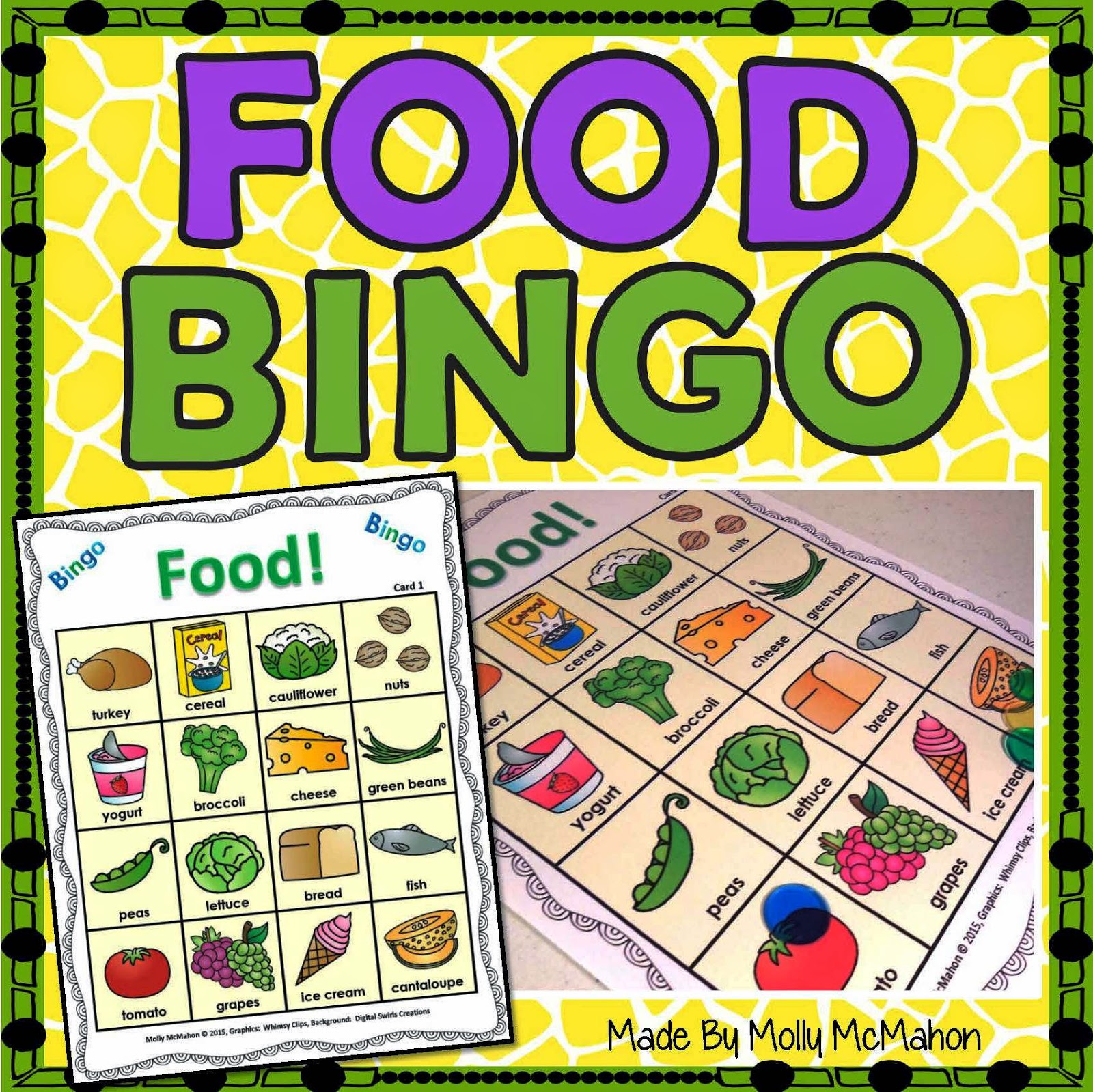
I made a few nutrition themed bingo games which are available at my Teachers Pay Teachers shop.  The one shown in the photo below uses BLACK ink from a printer.  There are 25 unique bingo cards included.  Each card has 24 foods which are from the FIVE main food groups.  All 25 bingo cards use the same 24 foods.  This avoids confusion!  The children know that they MUST find the word that is called out.  There is a free space in the center of the bingo card.   When the game is in play, the words can be covered with bingo chips, paint daubers, or small objects such as plastic cubes.

 
I have included a variation of the game.  Call out the food category instead of the name of the food.  This way, the children will have a choice as to which food to cover within a food group.  They will learn how to play strategically in order to win bingo.  With this version of the game, they will need to have an understanding of how foods are grouped to play the game efficiently.  The calling cards include the name of the food as well as the food group that it is categorized with.  If you are interested in purchasing this game, click on the image below to view it at my Teachers pay Teachers shop. 
https://www.teacherspayteachers.com/Product/food-groups-1777808


In addition to the bingo game shown above, I made another nutrition bingo game that would be ideal for pre-readers.  I changed some of the food names in this version.  The game shown below comes with 18 unique bingo cards.  It will require COLOR ink from a printer.  If you are interested, click on the image below: 
https://www.teacherspayteachers.com/Product/healthy-foods-1777894

Post written by Molly McMahon


Pinterest
Twitter
Teachers Pay Teachers

FREE & Paid Resources: Spring TPT Round-up of Speech & Language Activities


Spring is here and that means it is time to start planning lessons around spring!  I always hate having to spend lots of time looking for the perfect activity for my students, so I linked up a bunch of speech and language resources for quick therapy planning!

Come check out this post on my blog and find tons of resources all categorized by target area!  I have open-ended games, articulation, grammar, language, social skills, interactive file folder activities, book companions and more!

Stay Connected with me!

Monday, March 23, 2015

WHY I USE BOARD GAMES IN THE CLASSROOM... AND WHY YOU SHOULD, TOO!

I remember back in the good old days when I was a kid. One of my greatest joys in life was Friday afternoon. I would rush home from school with my sister; we’d inhale a snack; and then it would be board game time. Monopoly. Guess Who? The Game of Life. Holiday. Mouse Trap. Candyland. In my mind, it was one of the best parts of my childhood. It was simple, it was fun, and I spent a good portion of my week thinking about all the games we could play the following week after Friday afternoon had ended.

So when I became a teacher, I packed up some of my old games and took them into school for my class. Most of the boxes were old and falling apart. Some of the play money was missing. Many of the colors on the boards were starting to look extremely funky. And yet, when I unpacked the boxes into my cupboards at school…

…THE CHILDREN LOVED THEM.


I started lending the games to interested kiddos during lunch. I’m not going to lie, it was super fun to see the children enjoying games that I had loved during my childhood! But beyond that, I started noticing other positive benefits. I started noticing that kids who normally didn’t play together started to interact more because of the games. Boys and girls were more than happy to share games and play against each other. One student who often sat by himself at lunch started to join in – not as a player, but as a keen observer of other students playing against each other. From this, he began to form friendships with the ones who played, which was great to see. And another major plus was how the kiddos started to create their own games, bring them in and play!

Over the years, I have utilized games in the classroom to assist with reading, spelling, phonics, grammar and math. It seems that every time games are brought out, children get excited (and motivated!)… even if the games are (sneakily) teaching them something!

Here’s an example. I was teaching my kiddos about consonants and vowels – and whether to use ‘a’ or ‘an’ before the noun. They did really well during the lesson, but I found that a few weeks later there were still some children writing ‘a orange’ or ‘a egg’ in their writing books. Since the incomparable Krista from Creative Clips had just released some gorgeous clipart bunnies, I made this ultra-cute RAINBOW RABBIT ‘A’ OR ‘AN’ GAME.
RAINBOW RABBIT 'a' or 'an' GAME
(You can get the rabbit game HERE.)

It was a great way to reinforce the ‘a’ or ‘an’ concept, whilst keeping the children engaged. Afterwards, I put it in my early finisher basket. Of late, it’s been a class favorite… (Perhaps it’s something to do with Easter coming up?)

Here are some other class favorites from our early finisher basket.
CASTLE ON THE CLOUD GAME
common nouns, proper nouns, collective nouns, pronouns
(You can get the Castle on the Cloud game HERE).

ASSORTED EARLY FINISHER ELA GAMES
(You can get all 15 of the above games HERE).
 
So I encourage you to use board games in your classroom! They're motivating, educational and can assist children with social skills. And who knows? Perhaps one day one of your students will look back on their time in your class and remember it as the 'good old days'!

YOU MIGHT BE INTERESTED IN:
https://www.teacherspayteachers.com/Product/Early-Finisher-ELA-Games-Second-Grade-15-GAME-PACK-1775089

https://www.teacherspayteachers.com/Product/Early-Finisher-ELA-Games-First-Grade-15-GAME-PACK-1764154
 
 
ISLA HEARTS TEACHING