Showing posts with label #ELL. Show all posts

Monday, September 2, 2019

ESL UNITS FOR BACK TO SCHOOL OR ALL YEAR ROUND

SHOP TO HELP ME BUILD A CLASSROOM LIBRARY FOR MY ESL LEARNERS:

My English department needs English books to build a classroom library for our Grade 7-11 ESL learners in a small francophone school. Thus, from September 2019 through May 2020, I am offering my ESL UNITS BUNDLE at 30% off instead of 20% (Instead of $26, you will pay only $22.75). When you purchase this resource, the money will be used to fund our English department, so my colleagues and I can purchase the books we need for our students to promote reading and language learning. 
Click here to shop this resource:


What is included in this bundle?

Thematic unit: taking risks {competency-based & differentiated}, raising awareness of cultural diversity mini lesson/ice-breaker unit, environmental unit: plastic pollution mini lesson {video/listening and writing activities} and Edgar Allan Poe's "The Tell-Tale Heart" Short Story unit.

Pin it to share. Thank you for your support!


Kynga C. 


Thank you for stopping by TpT store! 

⇰ Visit the ESL in the Spotlight BLOG and join my mailing list to stay updated on teaching tips, resources and other ELL goodies. 

⇰ Let's connect on PINTEREST  and  FACEBOOK


Join The Best of Teacher Entrepreneurs Marketing Cooperative at


Go to http://www.pinterest.com/TheBestofTPT/ for even more free products!

Monday, August 26, 2019

My Favourite ELL Resources for Back to School


As I am looking forward to a new school year in my new school, I have already started planning and creating new resources. Since I have my classroom now and I can finally make the big decisions about the teaching materials I would love to use, I am all excited to be able to say good-bye to textbooks and use what I believe best responds to my learners' needs. If you are looking for some engaging and valuable resources for your textbook-less ESL class or you wish to supplement your own materials, here is a list of my favourite teaching resources that I have successfully used for years. These student-tested teaching materials along with some of my new creations are now available in bundled options in my Teachers Pay Teachers store so you can access them in one place. 

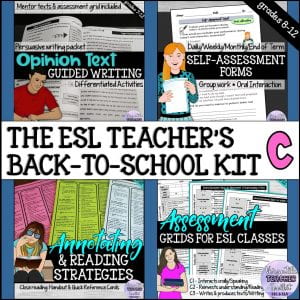
THE ESL TEACHER'S BACK-TO-SCHOOL KIT COLLECTION & THE ESL TEACHER'S MEGA BUNDLE
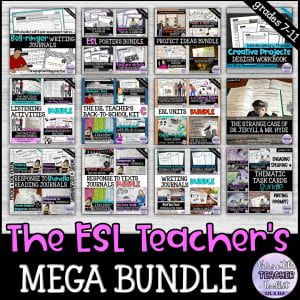


1. Persuasive/opinion text guided writing resource  (with mentor texts and differentiated activities)

My most cherished resource, which I have improved several times over the years, is my Opinion Text Writing workbook. This differentiated resource has been extremely useful to my learners, especially to struggling writers. The included mentor texts and guided writing practice have helped my learners improve their writing skills beyond expectations. You may find this item in Bundle C along with the self-assessment forms, ESL evaluation grids and annotating and reading strategies handout. 

2. Close reading: annotating and reading strategies handout
If you love teaching reading strategies as I do or you would like to improve your learners' reading skills, thus, understanding of texts, my annotating and reading strategies handout may also be useful in your ESL or ELA class. You may find this resource in Bundles C and D.

3. Thematic unit with a touch of growth mindset

Bundle A also includes a time-saving complete unit on taking risks. I teach high school ESL, so I always look for topics my learners are able to relate to. I enjoy starting the school year with this unit because I want to show my students that taking risks is something they should not be afraid of. In addition, I also want them to know that taking calculated risks and stepping out of their comfort zone are actions that will keep them moving forward not only in English class, but in life, too. 

4. Growth mindset posters and schedule/routine labels

Bundles A and B contain my recent watercolour classroom decor set including growth mindset posters, matching schedule/routine and teacher toolbox labels. If you would like to have a minimalist, but elegant classroom organization tool for your secondary ESL classroom, this watercolour set is your go-to resource. If you are not into watercolour classroom sets, Bundles D and E contain a different classroom set I also enjoyed creating. If you prefer having floral-themed growth mindset posters and matching schedule/routine labels in your class, you can opt for either Bundle D or E. 

5. Useful ESL posters - ESL competencies, student interaction, genre posters, spatial prepositions
I also love to have posters showing the ESL competencies in my classroom as I refer to them regularly. My collection of useful posters for the ESL class will nicely blend in with the purple watercolour classroom posters and labels. These practical ESL posters may be used as quick study guides, for example, when teaching the feature article. If you teach enriched ESL students in Quebec, a feature article poster should be a must-have item in your class. I have also created a couple of genre posters for my ESL class because we ask our learners to write journals, have them write or read biographies, essays, poetry or science fiction short stories and novels, yet, we spend little time on analysis and genre features. Rather, we expect our students to transfer knowledge from their L1, so we can focus more on content and language than in-depth structural analysis. These posters can help students refresh their memory of the main characteristics of different genres seen in their L1 literature classes. I believe that understanding the features of different text types not only helps learners to make more valuable self-to-text, text-to-text and text-to-world connections, but it also makes them better writers. So, I think that genre posters might come in handy in any ESL class. These posters are available in Bundles A, B and E.

6. ESL Evaluation grids

Another essential tool all ESL teachers should have is a set of print & go evaluation grids for all competencies. It has taken me years to perfect my assessment grids that also align with the ESL curricular requirements in Quebec. When I was a first-year teacher, my assessment rubrics were very detailed and made grading a burden. I wanted to be very thorough, but I soon realized that what I was doing was counterproductive. So, I have come up with more user-friendly rubrics that definitely make grading quicker and easier. Even though I know my assessment grids by heart now, I always give a copy to my students so they know what my expectations are and how I will evaluate their performance. For instance, at the beginning of the year, I hand out three essential assessment grids that my students need to keep in their binders: oral interaction (speaking skills), general rubric for reinvestment of understanding (reading skills) and writing. When grading their journals, written productions or written responses to texts, I use only a small quick scoring rubric stapled in learners' notebook, and invite them to have a look at the more detailed assessment grid in their binder to check what they did well and what still needs improvement based on the scoring rubric. You will find these evaluation grids (Quick scoring rubrics are already included.) in Bundles B, C, D and E. 


7. Self-assessment forms
I also like to hold my students accountable for their learning, so that is why I use self-assessment forms that my students need to complete after each class, group work, oral interaction and end of the term. These self-assessment forms are available in Bundle C, and you may use them on a daily, weekly or monthly basis or when your students complete a group assignment or interact orally. 

8. Thematic conversation task cards

Since oral interaction is at the heart of ESL, my collection of thematic task cards will certainly make your students talk. You can use them as speaking or writing prompts. All these conversation prompts are student tested and student approved. :) 

9. Back to school Student Information Handout
I have become tired of plain student survey forms, so I have come up with a student information handout that is more fun to complete. 

Look for "THE ESL TEACHER'S BACK-TO-SCHOOL KIT" bundles in my Teachers Pay Teachers store so you can save up to 30% on my favourite resources for back to school. Of course, you may also download all bundled items separately.

Let me know about your favourite resources in my Teachers Pay Teachers store, so I could make them available in a bundled format for back to school.  To visit my store, click here: Versatile Teacher Toolkit ESL and ELA Resources
Happy teaching!


Kynga C. 

You may also find these other bundled resources useful:                                                                                                                                                               


Thank you for stopping by TpT store! 

⇰ TpT store: VERSATILE TEACHER TOOLKIT ESL AND ELA RESOURCES

⇰ Visit the ESL in the Spotlight BLOG and join my mailing list to stay updated on teaching tips, resources and other ELL goodies. 

⇰ Let's connect on PINTEREST  and  FACEBOOK


Join The Best of Teacher Entrepreneurs Marketing Cooperative at
http://www.thebestofteacherentrepreneursmarketingcooperative.com/2014/01/the-best-of-teacher-entrepreneurs.html and get THOUSANDS OF PAGE VIEWS for your TpT products!


Go to http://www.pinterest.com/TheBestofTPT/ for even more free products!

Thursday, August 22, 2019

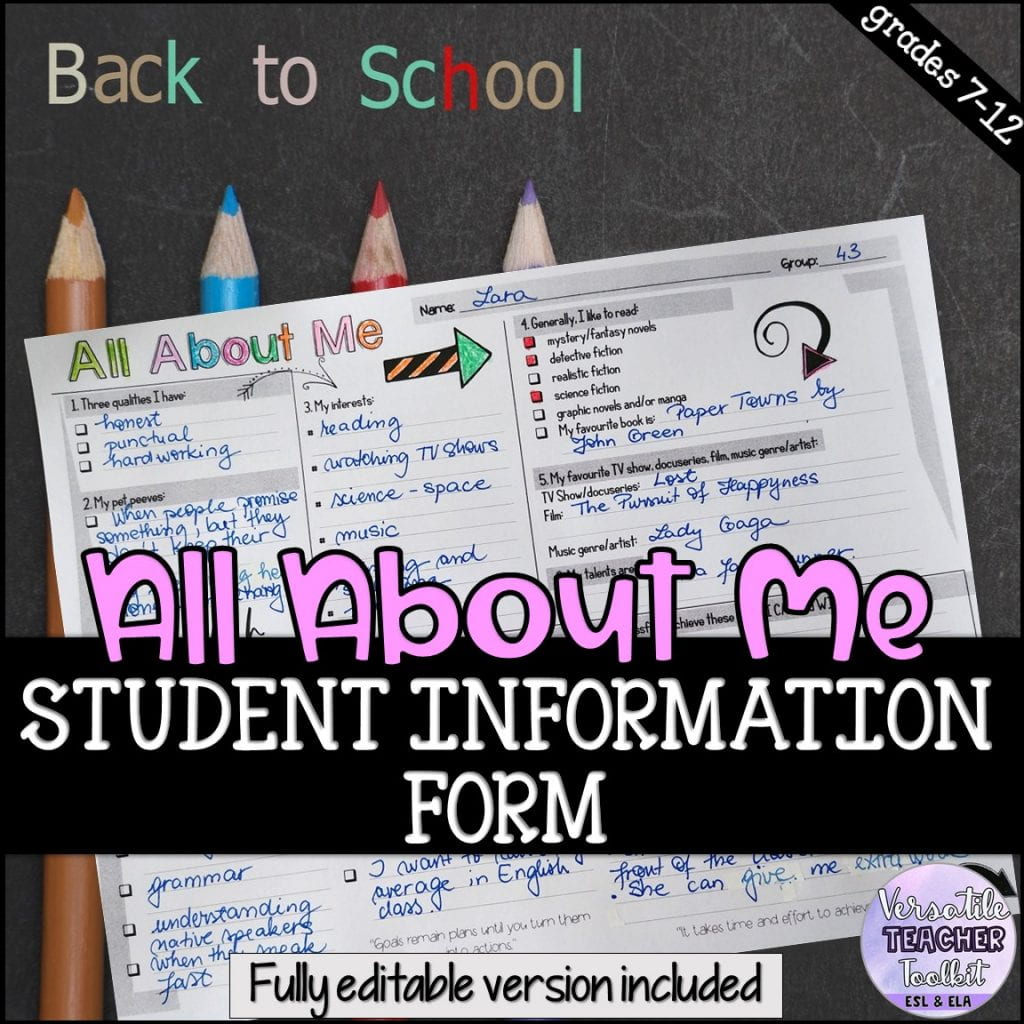
ALL ABOUT ME Student Information Form/Survey for Back to School (Editable)


Are you tired of plain student questionnaires on the first day of school? Use this two-pager back-to-school student information form to learn more about your secondary students. A fully editable version is also included, so you can adapt this resource to better suit your needs. 
Use this resource to learn more about:
  • students' qualities, pet peeves, interests
  • the types of novels, music genre, films, TV shows, artists they like
  • learners' strengths and difficulties (ESL skills/competencies: speaking, reading, writing, grammar) - You can change these using the editable version.
  • students' learning style
  • academic accommodations they had the previous year (e.g. extra time, computer for writing)
This student form also contains a written assignment section that you can use to evaluate your learners' writing skills.
This resource includes Canadian spelling.


Thank you for stopping by TpT store! 

⇰ TpT store: VERSATILE TEACHER TOOLKIT ESL AND ELA RESOURCES

⇰ Visit the ESL in the Spotlight BLOG and join my mailing list to stay updated on teaching tips, resources and other ELL goodies. 

⇰ Let's connect on PINTEREST  and  FACEBOOK


Join The Best of Teacher Entrepreneurs Marketing Cooperative at
http://www.thebestofteacherentrepreneursmarketingcooperative.com/2014/01/the-best-of-teacher-entrepreneurs.html and get THOUSANDS OF PAGE VIEWS for your TpT products!


Go to http://www.pinterest.com/TheBestofTPT/ for even more free products!

Wednesday, August 21, 2019

How I Teach Persuasive Writing to My High School ESL Learners


On the first day of school two years ago, I asked my Grade 10 ESL learners what aspect of English class they considered the most challenging. The answer was writing. They found writing difficult because they were short of ideas. Indeed, to have enough ideas, ESL learners need to read and collect information from various sources. That is why I hardly ever assign writing prompts out of context. Generally, I give my students writing prompts based on a text, video or multiple texts we have read in class, so they can skillfully select, organize and reinvest new information and language in an original written production. Of course, it is important to nurture students’ creativity and allow them to use their imagination by offering them quick writes or creative writing projects. However, when teaching a specific genre of writing in a mixed-ability classroom or to teenagers with learning difficulties, direct instruction and guided writing practice are always my go-to approaches. Even though I know that persuasive writing is a genre that students have certainly discussed in Grade 9, I never assume that they all know how to properly write an opinion piece when they arrive in Grade 10 or 11. 

PERSUASIVE WRITING WORKSHOP

When I teach persuasive writing in my Grade 10-11 classes, I use different sources to model the art of persuasion. By exposing learners to varied text types and offering them different kind of activities during our writing workshop, they are not only developing writing skills, but also other ESL competencies/skills such as oral interaction (speaking) and reinvestment of understanding of texts (reading and listening skills). Moreover, I also find important to choose a topic that appeals to the student population. For instance, most teenage learners  are often tired and sleepy in class, but little might they know about the scientific reasons behind their constant fatigue. That is why I like to introduce my writing workshop on persuasive writing with a discussion about sleep deprivation leading to the guiding question: Should the school day start later?. This is an issue that teenagers can personally relate to.

Once learners have shared their personal experience about being sleep-deprived teens, I continue with a TED Talk presentation to engage them and have them gather information for the opinion text they need to write at the end of the workshop. I usually show students one of my favourite TED Talks and excellent persuasive speech, Why school should start later for teens by Wendy Troxel. Of course, before watching, I set the purpose for listening by asking students to draw a T-chart in their notebook, so they can record all the advantages and disadvantages of starting the school day later while watching the video. I also invite them to pay attention to the techniques the speaker is using to grab their attention at the beginning, the way she is introducing her thesis and arguments, and the way she is closing her speech. I also remind learners to particularly pay attention to the end of the video when the speaker is inviting her audience to reflect on the issue raised in her presentation.


Data provided by TED

After watching, learners share their observations about the techniques used to persuade the audience, possibly administrators, politicians and people who have the power to change things in the community. Then, we also discuss the pros and cons they have recorded in their notebook. Discussing Wendy Troxel's speech as a whole class is not only an opportunity to assess learners’ understanding, but it also helps weaker learners jot down some ideas they might have missed while watching. After the whole-class discussion, I like to put students in small discussion teams (2 or 3 students) and ask them to list more examples of pros and cons from their experience. 
After carrying out this activity, learners continue working in small teams. To gather more information about the issue, I assign them two short articles in which they have to find the most relevant ideas to complete their pros and cons list. Of course, you may also assign this activity as individual work if you prefer so. 

I usually select articles related to the issue from the website newsela.com where you can choose the difficulty level of the texts, thus, they are ideal for differentiation. These articles are for ELA learners, but most of the texts are suitable for ESL students, as well. You will have to create an account to get access to the content, but their basic account is free. Here are some selected articles from the website Newsela that you may assign to your learners, but you can also find a lot of other relevant articles online:
  1. Later to rise, not earlier to bed, for today's tired teens, doctors say
  2. Later start times, less homework to help students cope with stress
  3. Study shows kids' brains work better with more naps
  4. Giving schools a later start would create a huge financial benefit
  5. New research on deep sleep helps solve the mystery of memory
Please verify the above texts to decide if they are appropriate for your learners.

By now, students’ pros and cons list should contain enough ideas. Well, they might have enough meet to work with, they still need to know how to organize their ideas coherently. So, this is the moment when I walk learners through the structure of a persuasive/opinion text using direct instruction and guided writing practice.


DIRECT INSTRUCTION AND GUIDED WRITING PRACTICE

Wendy Troxel’s presentation is an exemplary persuasive speech that students can learn so much from, but I want to expose them to written works, as well. I usually use two mentor texts. One of them is a short text helping even my struggling learners to grasp the most important elements of a well-structured opinion piece, the other one is a more developed text in response to our writing prompt: Should the school day start later?.

The reason why I would want to give my students mentor texts written on the same issue is not only a personal choice, but it is also a differentiated learning technique to offer learners all the possible avenues for developing good writing skills. On the one hand, I can use these mentor texts to model content, structure and language. On the other hand, opinion text models on the same issue will give struggling writers more confidence when they need to produce their own piece of writing at the end of the workshop. If you worry about students copying the exact sentences from these texts, state your expectations clearly, and everything should be fine.

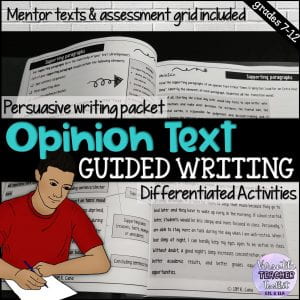
Whenever I guide my students through the steps of writing an opinion piece, I use the opinion text guided writing workbook I have designed for my ESL learners and have improved over the years. 


This resource is a deconstructed step-by-step guide assisting students in writing introductions, formulating clear opinions on an issue, writing supporting paragraphs and conclusions. Of course, depending on my students’ needs, I might need to spend more or less time on analyzing the structure of an opinion text or on completing the guided writing activities in this resource. You may check out this Opinion/Persuasive Text Guided Writing Workbook here.

By the end of this writing workshop, learners should have acquired all the necessary skills to confidently write their opinion piece in which they answer the guiding question proposed at the beginning of our workshop: Should the school day start later? 

If you want to read more about how I teach the response process using videos, click here

I would be glad to hear about the way you organize your writing workshops when teaching persuasive writing. Please share your ideas in the comment section.

Happy teaching!

Kynga C. 


Thank you for stopping by TpT store! 

⇰ TpT store: VERSATILE TEACHER TOOLKIT ESL AND ELA RESOURCES

⇰ Visit the ESL in the Spotlight BLOG and join my mailing list to stay updated on teaching tips, resources and other ELL goodies. 

⇰ Let's connect on PINTEREST  and  FACEBOOK


Join The Best of Teacher Entrepreneurs Marketing Cooperative at
http://www.thebestofteacherentrepreneursmarketingcooperative.com/2014/01/the-best-of-teacher-entrepreneurs.html and get THOUSANDS OF PAGE VIEWS for your TpT products!


Go to http://www.pinterest.com/TheBestofTPT/ for even more free products!

Monday, April 10, 2017

April Teacher Talk

Posted by Deann Marin of Socrates Lantern


It's April and so many groovy things are happening this month, Easter, Passover, spring vacation and so much more. Be sure to stop by and see what these teachers are doing in their classrooms and gather some great tips and ideas.

If you're interested in joining this unique group of teacher entrepreneurs, blogging buddies and/or our blog linky, sign up here....The Best of Teacher Entrepreneurs Marketing Cooperative. If you decide to join, be sure to mention one of our names.
************************************************************
If You Love Jelly Beans
By Deann Marin of Socrates Lantern
Can’t you just smell spring in the air? Daffodils beginning to bloom, Lilac trees starting to flower, and Lilies of the Valley popping up. I just love the aroma. Not only is my birthday in April but it brings us Passover, Easter, and one that you may never have heard of, can you guess? If you said Jelly Bean Day, you’d be right. It's April 22nd.
**************************************************
Plan a Portfolio Party
By Retta London of Rainbow City Learning

Plan a celebration for your young writers as they bloom in the Spring!
***************************************************
April Math FUN!
By Sara Snyder of Snyder Classroom
Make Math FUN this Spring! These spring math riddles are great for reviewing previous topics or practicing current skills. These riddles can be helpful in your classroom at this busy time of year. (And sneak a little fun into the classroom) I have made these math riddles to combine fun and learning for this time of year.
***********************************************
How Many Ways are Words Related?
By Susan Berkowitz of Susan Berkowitz
Individuals who use AAC need to learn to take a conscious path to the words they need. If they want an apple, they need to think about how to navigate to categories -> to food -> to fruit -> to apple. SLPs can help them learn how to do this.
**************************************************
6 Tips to Support English Language Learners in Your Classroom
By Kathy Simpson of Sunshine and Lollipops
Do you have English Language Learners in your classroom? If you do...you will want to take a look at this post and discover 6 easy and fun tips to support your ELL students. I am sure you will LOVE #1!
***********************************************
Apollo 13: The Ultimate STEM Challenges
By Kerry Tracy of Kerry Tracy
The Apollo 13 mission shows how seemingly insurmountable obstacles can be overcome with scientific reasoning and problem solving. Specifically, the carbon dioxide filter fix shows why STEM Challenges are so much more than just "fun."
**********************************************
The Magic of a Circle
By Kathie Yonemura of Tried and True Teaching Tools
Using only a circle, students fold and learn a multitude of geometric terms. This is a fantastic way to teach geometry and for students to experience more than just shapes!
*************************************************
Increase Engagement and Maintain Rigor-Hands-on Fun in the Upper Grade and Middle School Classroom
By Marcy Howe of It's a Teacher Thing
Maintaining student motivation is important during any time of year, but it's even more crucial when they return from a break. I save several of my "great" activities for those Mondays after a week off.
**********************************************************
Poppies & Pantoums: Poetry Comes Alive with Georgia O'Keefe
By Tracy Willis of Wild Child Designs
4th and 5th grade students explore the life of Georgia O'Keefe via a biography and her fabulous artwork. We look closely at the natural world using photographs and author Pantoum poems, a cool poetic form from Malaysia. We recuperate from our testing angst with a poppy craft.
***************************************************************
Painting Poetry: Children's Voices
By Virginia Musmanno of Reading Spotlight
We hope that you will take one minute out of your busy day to enjoy a slideshow of our paintings of poems. We hope that you enjoy seeing them as much as we enjoyed painting them!
**********************************************************
Make sure you visit these great posts from some awesome educators.